
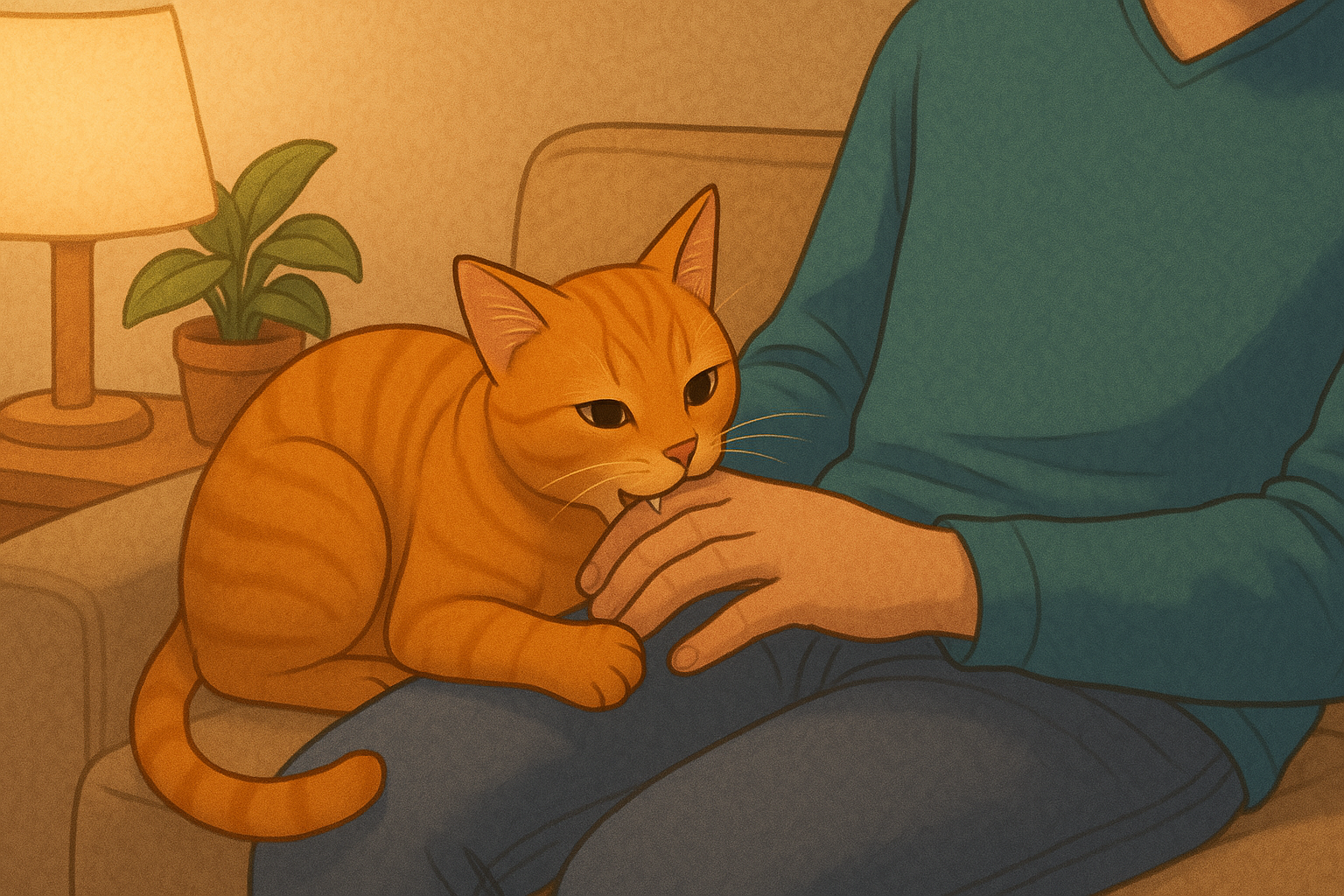
Cuddles with your cat are supposed to be cozy, right? But for many cat parents, snuggle sessions can take a sudden turn — just when things are peaceful and purring, chomp. If you’ve ever been surprised by a post-cuddle nip, you’re not alone. While it might feel confusing or even a little rude, this is actually a common feline behavior. Let’s see what’s really going on behind those affectionate-but-pointy teeth.
📬 Letter to Tabby
Dear Tabby,
My cat loves curling up in my lap and getting pets, but almost every time, just when I think we’re having a cute moment… she bites me! Not hard enough to break skin, but definitely a nip. I’m confused. Is this normal cat behavior? Is she mad at me?
— Bitten but Bewildered in Boston
🐱 Tabby Replies:
Oh, Bewildered — I feel this one in my whiskers. You think everything’s going smoothly: the purring, the warm cuddles, the slow blinks — and then boom. A tiny chomp. We cats really know how to keep the vibe confusing, don’t we?
Let’s decode why your cuddle session ends with a love bite (or a leave me alone bite).
🧠 Mixed Signals: Cats and Sensory Overload
Sometimes we purr through it… right until we can’t anymore.
This is known as petting-induced aggression, and it’s surprisingly common — especially in cats who enjoy affection but on their own terms.
What’s happening:
- Repeated petting overstimulates our nerve endings
- We go from “cozy” to “too much” very quickly
- A bite is our way of saying: “I’m done now.”
You may not notice any warning signs, but we’re likely giving subtle cues like:
- Flicking our tail
- Flattening ears
- Stopping purring
- Twitching skin
If you ignore those… yeah. We’ll escalate.
💕 Sometimes… It’s a Love Bite
Yup, that’s a thing.
Some cats bite very gently after affection as a weird, endearing expression of affection. It’s kind of like a toddler squeeze — just a little rougher than expected.
These are usually:
- Soft nibbles
- No growling or hissing
- Followed by calm behavior
You can usually tell it’s a love bite if we stay with you after — not run off or look annoyed.
🧬 It’s In Our Instincts
Biting is a normal part of feline communication. In the wild, we use gentle biting during grooming or play. For domesticated cats, this sometimes spills over into human interaction — especially when we’re feeling overstimulated or playful.
Kittens often bite littermates during social play. If we weren’t taught boundaries early on, we may never learn the “okay that’s too much” point.
🛑 How to Handle the Biting
Here’s how to prevent your cuddle time from ending in a chomp:
- Learn your cat’s body language.
Stop petting when the tail flicks or ears twitch. Know their “I’m done” signs. - Keep petting sessions short.
1–2 minutes of affection is often the sweet spot. - Change petting spots.
Avoid sensitive areas like the belly or base of tail (unless your cat is into that — respect the individual). - Never punish biting.
It’ll just confuse or scare us. Instead, calmly stop the interaction. - Reward calm behavior.
Give a treat when we disengage gently — help us build good exit strategies.
🐾 Tabby’s Final Word
You’re not doing anything wrong, Bewildered. You’re just loving a creature with very specific comfort settings — kind of like a furry, emotionally complicated toaster oven.
We don’t bite because we don’t love you. We bite because we do — but our language is a little… sharper.
Learn our signals, respect the pause, and your cuddles will become drama-free in no time.